
Terahertz-Driven Hot Electron Transport in Twisted Bilayer Graphene
Artist’s illustration of two graphene sheets rotated relative to one another, creating a moiré pattern. An incident terahertz radiation (red wave) deposits energy into the electronic system, producing a population of hot electrons (orange), depicted with short, irregular trajectories. Farther from the illuminated region, cooler electrons (blue) travel without scattering over larger distances.
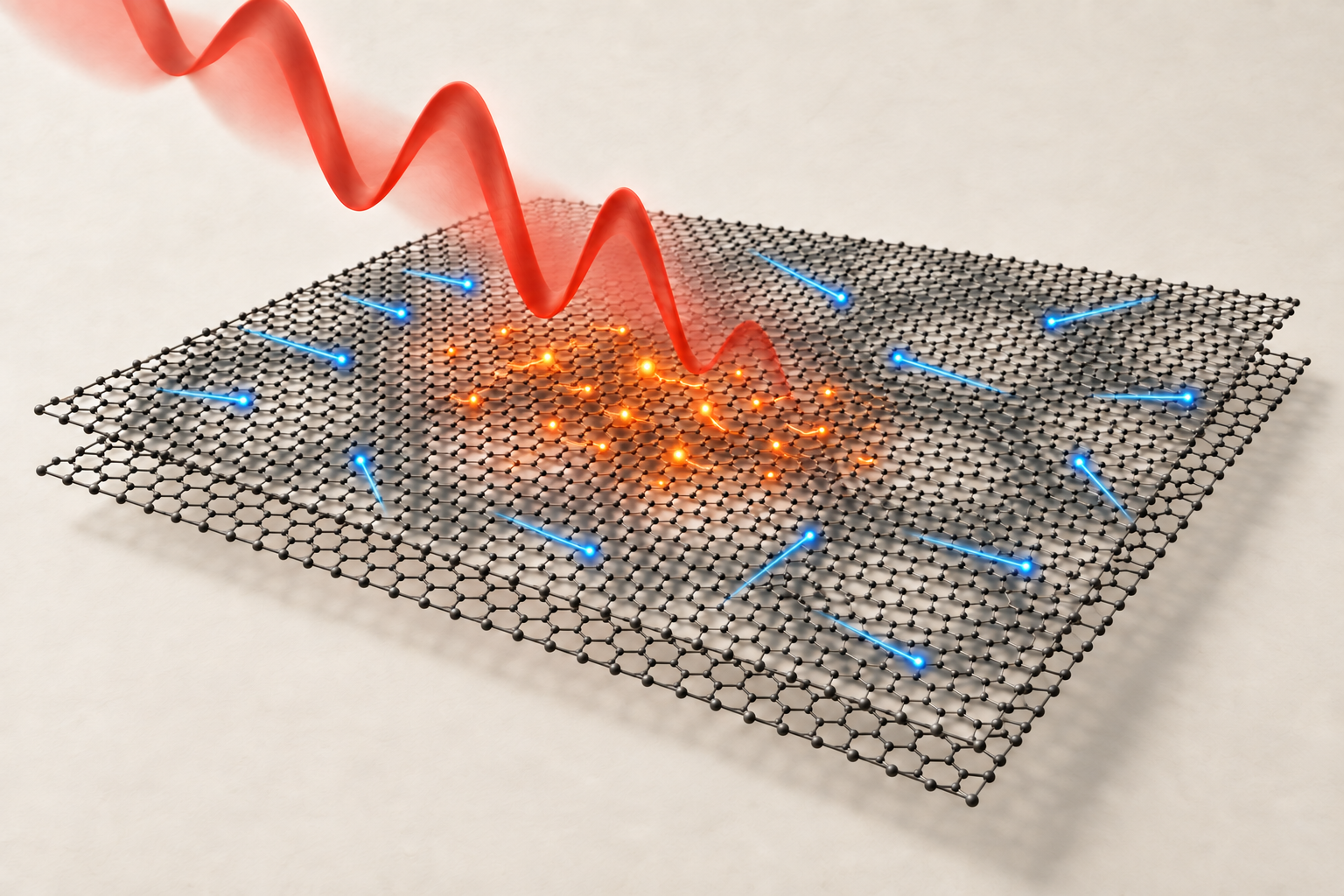
[By warming electrons while leaving the atomic lattice cold, NUS I-FIM researchers have separated two competing influences on how current moves through a quantum material.]
When a material heats up, its electrical resistance often rises. The harder question is what, exactly, is getting in the way.
The electrons carrying the current may be scattered by vibrations of the material’s atomic lattice, known as phonons. They may also collide with one another. Frustratingly, a conventional temperature test warms the electrons and the lattice together, so the effects arrive tangled in the same resistance measurement.
Researchers from the Institute for Functional Intelligent Materials (I-FIM) at the National University of Singapore (NUS) have now pulled those effects apart in twisted bilayer graphene, a material made by stacking two sheets of graphene at a slight angle. In a paper published in Nature Communications on 13 August 2026, the researchers used terahertz radiation to warm the electrons while keeping the surrounding lattice almost unchanged. The material’s resistance climbed by several kilo-ohms in devices twisted close to the so-called magic angle, revealing a strong electronic contribution even in regimes often associated with phonons.
“Conventional transport measurements heat the electrons and the lattice together, so their fingerprints are superimposed,” said Assistant Professor Denis Bandurin, a Principal Investigator at I-FIM, who led the study. “We wanted to separate those two temperatures and ask what the electrons themselves were doing.”
A small twist creates a large puzzle
Graphene is a single layer of carbon atoms arranged in a honeycomb. When two such layers are rotated slightly out of alignment, their overlapping lattices produce a larger repeating pattern called a moiré superlattice. That pattern reshapes the energy landscape through which electrons move.
Near a twist of about 1.1 degrees, known as the magic angle, some electronic energy bands become unusually flat. Electrons then move more slowly and feel one another more strongly, helping the material host correlated insulating states, superconductivity and other collective behaviour. It also complicates one of the simplest measurements in electronics: how resistance changes with temperature.
In a conventional Fermi liquid — the standard description of interacting electrons in many metals — resistance caused by electron interactions often grows with the square of temperature, or T-squared. A resistance that rises linearly with temperature can instead point to scattering by phonons, although it has also been associated with “strange metals” that do not fit the conventional bill.
Twisted bilayer graphene has displayed both trends, with the exponent changing as researchers vary the twist angle and the number of charge carriers. A temperature curve alone can therefore support several competing explanations.
“In twisted bilayer graphene, the same temperature dependence can have more than one plausible microscopic origin,” said Artur Shilov, a PhD student at I-FIM and first author of the paper. “We needed another control knob.”
Heating the carriers instead
The team built tiny bar-shaped devices from twisted graphene encapsulated in hexagonal boron nitride, an electrically insulating material that protects the carbon layers. Graphite gates controlled the number of charge carriers, while metal antennas channelled 0.14-terahertz radiation into the graphene.
Each terahertz photon carried only 0.6 millielectronvolts of energy, too little to drive electrons directly between the relevant energy bands. Instead, the radiation stirred the existing charge carriers. Those carriers redistributed the energy among themselves within femtoseconds (millionths of a billionth of a second) and settled into a hot electronic state before they could pass much of that heat to the lattice.
At the highest radiation power, the electrons were estimated to reach temperatures about 20 kelvin above the lattice, which was held near 2 kelvin. Dedicated heat-transport tests placed the maximum rise in lattice temperature below 1 kelvin, and separate electrical noise measurements supported the conclusion that the electrons and lattice remained thermally decoupled.
The researchers then compared the devices’ resistance in the dark and under terahertz illumination. Across the metallic regions of devices with different twist angles, heating the electrons produced a large positive photoresistance — an increase in resistance caused by the radiation. The response grew with terahertz power before levelling off. Close to the magic angle, it reached several kilo-ohms.
A control device made from a single sheet of graphene behaved differently. Away from special magnetic-field effects, heating its electrons produced almost no photoresistance, as expected when phonons set the material’s resistance.
“The comparison is what gives the measurement its force,” Artur Shilov said. “When the lattice stays cold and the resistance still rises sharply, the response is tied primarily to the hotter electronic system.”
When conserving momentum does not conserve current
A second finding made things even more interesting. In devices twisted farther from the magic angle, the team observed the familiar T-squared resistance at densities as low as 100 billion charge carriers per square centimetre, which is exceptionally dilute for these devices. The effect appeared where the usual ways for electron-electron collisions to dissipate current should be unavailable.
The problem is that electrons colliding in a perfectly clean, conventional metal conserve their total momentum. Like billiard balls striking one another on a frictionless table, they can exchange momentum without slowing the group as a whole. To produce resistance, the electron system needs a route for relaxing the current. One such route is umklapp scattering, in which the lattice absorbs momentum. Another involves collisions between different carrier bands. At the low densities probed here, the geometry of the available electronic states rules out these standard channels.
Twisted graphene, however, does not obey the simple relationship between velocity and momentum assumed for an ordinary parabolic energy band. Its Dirac-like bands break what physicists call Galilean invariance. The moiré pattern also leaves electrons in several distorted pockets, or valleys, in the material’s band structure.
The researchers propose that collisions between these valleys can change the electrons’ velocities enough to reduce the current, even while total momentum is conserved. Their calculations placed the expected T-squared resistance coefficient between 0.005 and 0.5 ohms per kelvin squared, depending on how strongly other charges screen the interaction. The measured value, about 0.1 ohms per kelvin squared, fell within that range.
The team noted that while that agreement makes intervalley scattering a plausible mechanism, it does not prove that it is the only one. The theoretical range remains broad, and the detailed influence of screening and the shape of the electronic wave functions still need to be resolved.
“We are proposing a mechanism that is compatible with both the band structure and the size of the observed effect,” said Professor Dmitrii Maslov from the University of Florida, who led the theoretical analysis with his PhD student Joshua Covey and Dr. Alessandro Principi from the University of Manchester. “The microscopic picture is not closed. The method helps us rule out some explanations and shows us where the remaining question lies.”
A new lens on quantum transport
The team’s work adds a new experimental dimension to the study of quantum transport. Researchers have often had to infer the dominant scattering mechanism from the shape of a temperature-resistance curve. By controlling the electron and lattice temperatures separately, the terahertz method can test their contributions more directly. In twisted bilayer graphene, it brings the linear-in-temperature response near the magic angle and the quadratic scaling at higher angles into a common picture: in both regimes, electronic interactions play a major role in limiting current.
The approach could be applied to other moiré systems and low-density quantum materials in which conventional transport measurements blend electronic and lattice effects. Identifying which interactions dominate would give researchers a firmer basis for evaluating competing theories and building more accurate models of how charge moves through correlated materials.
“A next step is to extend these measurements to larger twist angles, where the graphene layers increasingly approach the decoupled limit,” Asst Prof Bandurin added. “Following how the electron-electron and electron-phonon contributions change enables us to work towards explaining the crossover between quadratic and linear-in-temperature resistance. The same hot-electron approach could also be used to test transport mechanisms in other moiré and low-density quantum materials.”