
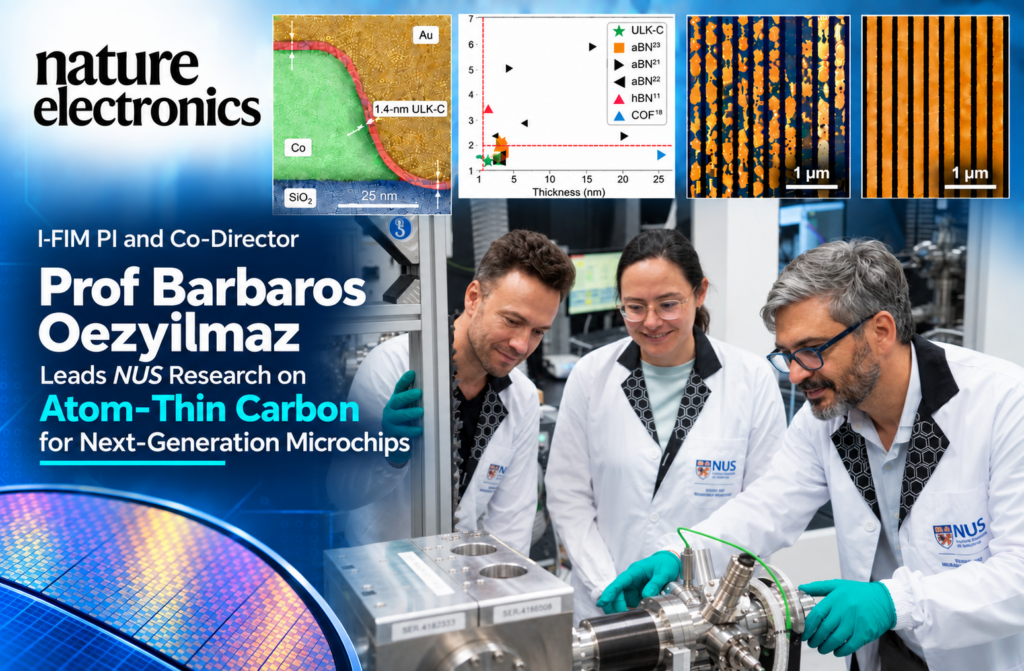
Professor Barbaros Oezyilmaz, Principal Investigator and Co-Director of the Institute for Functional Intelligent Materials (IFIM), has led a research team that developed an atomically thin amorphous carbon film with an ultralow dielectric constant, addressing a key materials challenge in next-generation microchips.
The research, titled “Atomically Thin Amorphous Carbon with an Ultralow Dielectric Constant,” was published in Nature Electronics on 18 August 2026.
As microchips continue to shrink, the dense network of metal interconnects connecting devices across a chip is becoming an increasing obstacle to speed and energy efficiency. As the gaps between these metal lines become smaller, unwanted electrical interactions between neighbouring interconnects can increase, contributing to what is known as the interconnect bottleneck.
The team developed a multilayer amorphous carbon film that can be grown to thicknesses as low as 0.8 nanometres, while maintaining an ultralow dielectric constant, or k-value, of 1.35. The film also demonstrated a dielectric strength of 28–31 MV cm⁻¹ and strong resistance to copper-ion diffusion.
These properties could allow the material to serve two functions in a single ultrathin layer: as an ultralow-k dielectric to insulate metal interconnects and as a barrier against copper-ion diffusion. Combining these functions could reduce the need for separate barrier layers, freeing valuable space for copper lines as interconnect dimensions continue to shrink.
The carbon film maintained a k-value close to 1.35 across thicknesses from 0.8 to 2.7 nanometres, remaining below the industry target of a k-value of 2 as interconnect gaps shrink below 10 nanometres. The film also withstood strong electric fields and demonstrated a measured hardness of approximately 100 gigapascals, at least ten times that of silicon dioxide.
The researchers produced the film using chemical vapour deposition at temperatures below 300°C, achieving uniform growth across a four-inch wafer and around the sidewalls and corners of patterned structures.
The work builds on the team’s 2020 Nature report on stable, free-standing monolayer amorphous carbon and forms part of a wider research programme supported by the National Research Foundation (NRF) Competitive Research Programme.
The team is now working to move the material from laboratory research towards semiconductor manufacturing. In April 2026, NUS commenced a formal research collaboration with TSMC to evaluate the material for ultralow-k insulation and chipmaking. Three months later, the team began an NRF Central Gap Fund project to scale its low-temperature, ultraviolet-assisted deposition process and address integration, reliability and manufacturability.
“Our next task is to translate this performance to industry-relevant wafers and determine how the film can be incorporated into existing chipmaking processes,” said Prof Oezyilmaz.
The research highlights the potential of atomically thin amorphous carbon for addressing challenges in continued semiconductor scaling, with potential applications extending beyond conventional interconnects to photonics and interlayer dielectrics in monolithic 3D integration.
Read the full paper in Nature Electronics: Atomically Thin Amorphous Carbon with an Ultralow Dielectric Constant