
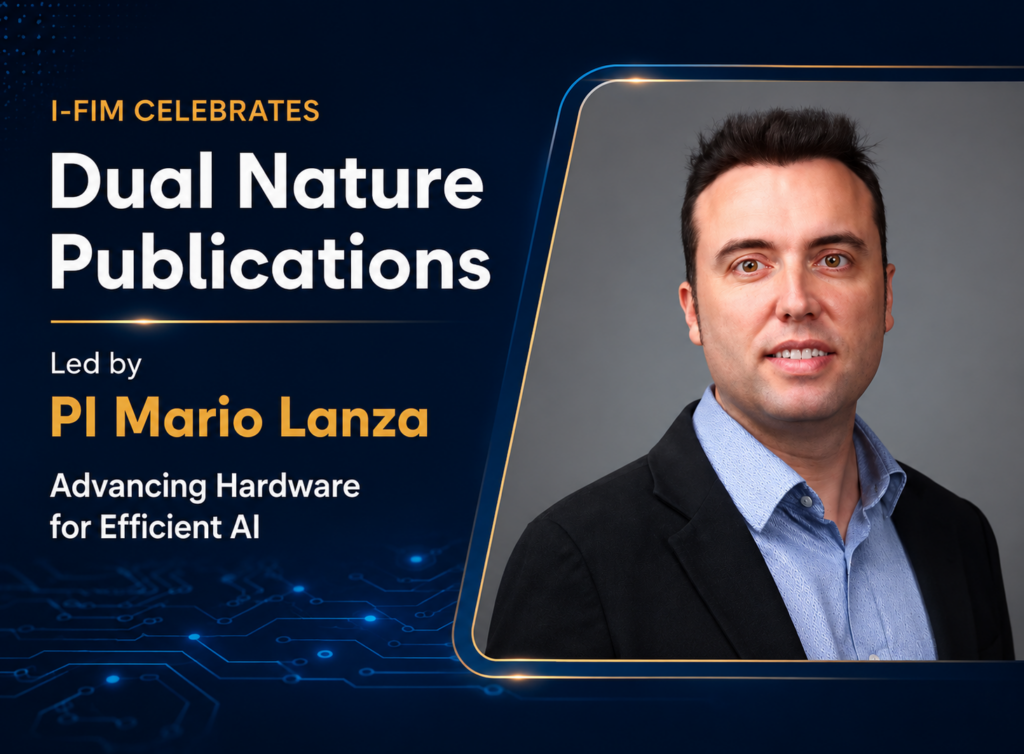
Associate Professor Mario Lanza, Principal Investigator at the Institute for Functional Intelligent Materials (I-FIM) and faculty member in the NUS Department of Materials Science and Engineering, has led two high-impact publications in Nature this year, marking a major milestone in I-FIM’s mission to pioneer energy-efficient hardware for next-generation artificial intelligence.
The first article, titled “Synaptic and neural behaviours in a standard silicon transistor,” demonstrates that a single conventional CMOS transistor can mimic both synaptic and neural functions when operated under a specifically engineered biasing regime. This breakthrough enables up to 18× smaller neurons and 6× smaller synapses, while maintaining complete compatibility with mature semiconductor manufacturing technologies such as those available locally in Singapore.
DOI: https://doi.org/10.1038/s41586-025-08742-4
Complementing this advance, Prof. Lanza also co-led a Nature Perspective article, “The growing memristor industry,” which analyses the rapid industrialization of memristive technologies. The work highlights commercial deployments, high-readiness prototypes, and the crucial pathways enabling compact, low-power computing systems for AI and the Internet of Things.
DOI: https://doi.org/10.1038/s41586-025-08733-5
Together, these publications highlight I-FIM’s growing contributions to neuromorphic and memristive device research, supporting NUS’ strategic focus on intelligent materials and future semiconductor technologies.